
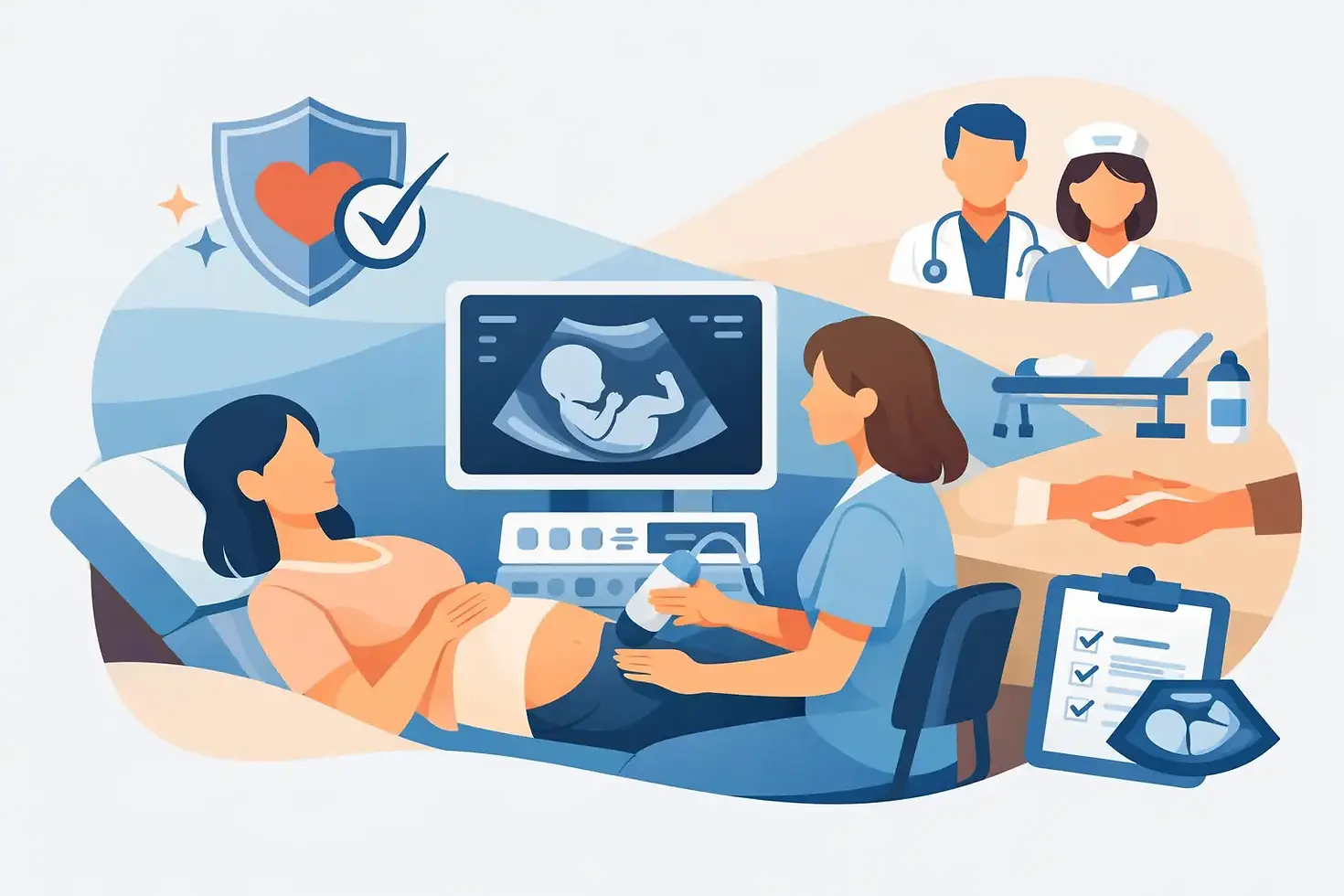
Is Private Ultrasound Safe? What Good Care Looks Like

A pregnancy reassurance scan can feel like the quickest route to calm after a worrying few days. A pelvic or abdominal scan may feel equally urgent when you are dealing with symptoms and long waits. But it is right to ask, is private ultrasound safe? The answer is yes, when the scan is clinically appropriate and carried out by properly qualified professionals in a well-governed setting. The provider, the purpose of the scan and the plan for your results all matter.
Ultrasound itself has been used in medical care for decades. It does not use ionising radiation, unlike X-rays or CT scans. Instead, it uses high-frequency sound waves to create images of structures inside the body. That makes it a valuable tool in pregnancy, fertility and many health assessments. Safety is not simply about the machine, though. It is also about how and why it is used.
Is private ultrasound safe for pregnancy and health scans?
A private ultrasound can be a safe and reassuring choice when it complements appropriate medical care rather than replaces it. A qualified sonographer should use the lowest practical level of ultrasound exposure for the shortest time needed to obtain useful images. This principle is especially relevant in pregnancy, where scans should have a clear purpose - whether that is confirming an early pregnancy, checking development, assessing placental position later in pregnancy or providing a carefully performed wellbeing and bonding experience.
For health and fertility scans, the same standard applies. An abdominal scan, pelvic assessment, follicle count or testicular scan should be performed with a clear clinical question in mind. A scan may help identify findings that need further investigation, but it cannot always provide a final diagnosis on its own. Blood tests, an examination, repeat imaging or referral to your GP or specialist may still be needed.
The key distinction is between a professional clinical service and a scan that treats imaging as entertainment. Reassurance and memorable images are meaningful parts of the experience for many families, but they should sit alongside good clinical practice, not take its place.
What makes an ultrasound provider safe?
The most useful question is not only whether the scan is private. It is who is carrying it out, what standards guide their work and what happens if something unexpected is seen.
A reputable clinic will be transparent about its sonographers' qualifications and professional registration. In the UK, many diagnostic sonographers are registered with the Health and Care Professions Council (HCPC), or work under appropriate professional governance. Their training and experience allow them to optimise the scan, recognise normal and abnormal appearances, explain the limits of ultrasound and act appropriately when follow-up is needed.
Clinical governance matters too. Look for a service with clear protocols, secure record keeping, infection-control procedures, consent processes and an established pathway for escalation. Where registration with the Care Quality Commission (CQC) applies, it offers an additional layer of oversight. Accreditation and ongoing professional development also demonstrate that quality is being treated as a continuing responsibility, not a one-off claim.
At Nu Scan Ultrasound, scans are delivered in a sonographer-owned setting, with experienced, NHS-trained professionals and a focus on clear, patient-centred communication. That combination matters because a calm appointment should never come at the expense of clinical standards.
The equipment matters, but it is not the whole story
Modern ultrasound equipment can produce excellent images and help a skilled sonographer assess detail with confidence. However, an advanced scanner is only as safe and useful as the person operating it. A good provider does not promise that every scan will show every answer. They explain what the scan can assess, what may be limited by factors such as pregnancy stage, bowel gas or body shape, and what happens next if the images are unclear.
This honest approach is a sign of good care. Ultrasound is highly useful, but it has limits. For example, a normal scan does not necessarily rule out every possible cause of pain, bleeding or other symptoms.
When a private scan is not enough
Private ultrasound offers faster access and can provide valuable reassurance or information. It should not delay urgent medical care. If you have severe or worsening pain, heavy bleeding, shoulder-tip pain in early pregnancy, fainting, chest pain, shortness of breath, a high fever or feel seriously unwell, seek urgent help through NHS 111, your maternity unit, GP or A&E as appropriate.
In early pregnancy, an ultrasound may not yet show everything you hope to see. Dates can be earlier than expected, and follow-up scanning or blood tests may be clinically necessary. A responsible clinic will explain this sensitively rather than giving false reassurance. Likewise, if a health scan identifies a possible concern, the right next step may be a GP appointment, an urgent referral or further imaging through an NHS or specialist pathway.
A private provider should be clear that it does not replace antenatal appointments, screening offered by your NHS maternity service, routine cervical screening or ongoing care for known medical conditions. Think of a private scan as one part of your care, with a defined purpose and a clear route onwards if needed.
Questions worth asking before you book
Before choosing a clinic, ask whether the person performing your scan is a qualified sonographer, what professional registration or accreditation they hold, and whether the service has CQC registration where required. You should also be able to ask what is included in the appointment, whether you will receive images or a written report, and how any unexpected finding will be managed.
For a pregnancy scan, ask about the recommended gestation for the scan you want. Early reassurance, gender and 4D scans are best booked at different stages, and a good clinic will guide you rather than simply accepting a booking that is unlikely to meet your expectations.
For a health or fertility scan, be specific about your symptoms, previous test results and the reason for your appointment. This helps the sonographer understand the clinical context. It also helps you choose the right scan - an abdominal scan, pelvic scan, gynaecology assessment or fertility-focused appointment may answer different questions.
Price is understandably part of the decision, particularly when you need quick access. Affordable pricing is helpful, but it should not be the only measure of value. The safer choice is a service that makes time for your questions, uses appropriate equipment and has the expertise to provide clear findings and next-step advice.
What a safe appointment should feel like
You should feel informed before the scan begins. The sonographer should explain the examination, gain your consent and give you an opportunity to raise concerns. For intimate scans, such as transvaginal pelvic or prostate imaging, dignity, privacy and clear explanation are essential. You can ask questions, request a chaperone where appropriate and stop the examination at any point.
During the scan, the room should feel clean, private and unhurried. A skilled sonographer may need periods of concentration to obtain accurate images, so a quiet moment does not automatically mean anything is wrong. They should explain findings in an understandable way once they have completed the assessment, without making claims that go beyond what the scan can show.
Afterwards, you should know what your result means in practical terms. That may be simple reassurance, a recommendation to discuss the report with your GP, or advice to seek more urgent care. Clear communication is one of the strongest safety features a private clinic can offer.
Private ultrasound is safest when it is expert-led, appropriately timed and connected to the right follow-up care. If you are considering a scan, choose a clinic that welcomes your questions and treats your reassurance, dignity and health with equal care.


Comments