
3D vs 4D Baby Scan: What’s the Difference?

If you are comparing a 3d vs 4d baby scan, you are probably not looking for technical jargon. You want to know what you will actually see, when to book, and whether one option is better for bonding, reassurance, or both. That is exactly where clear, expert guidance matters.
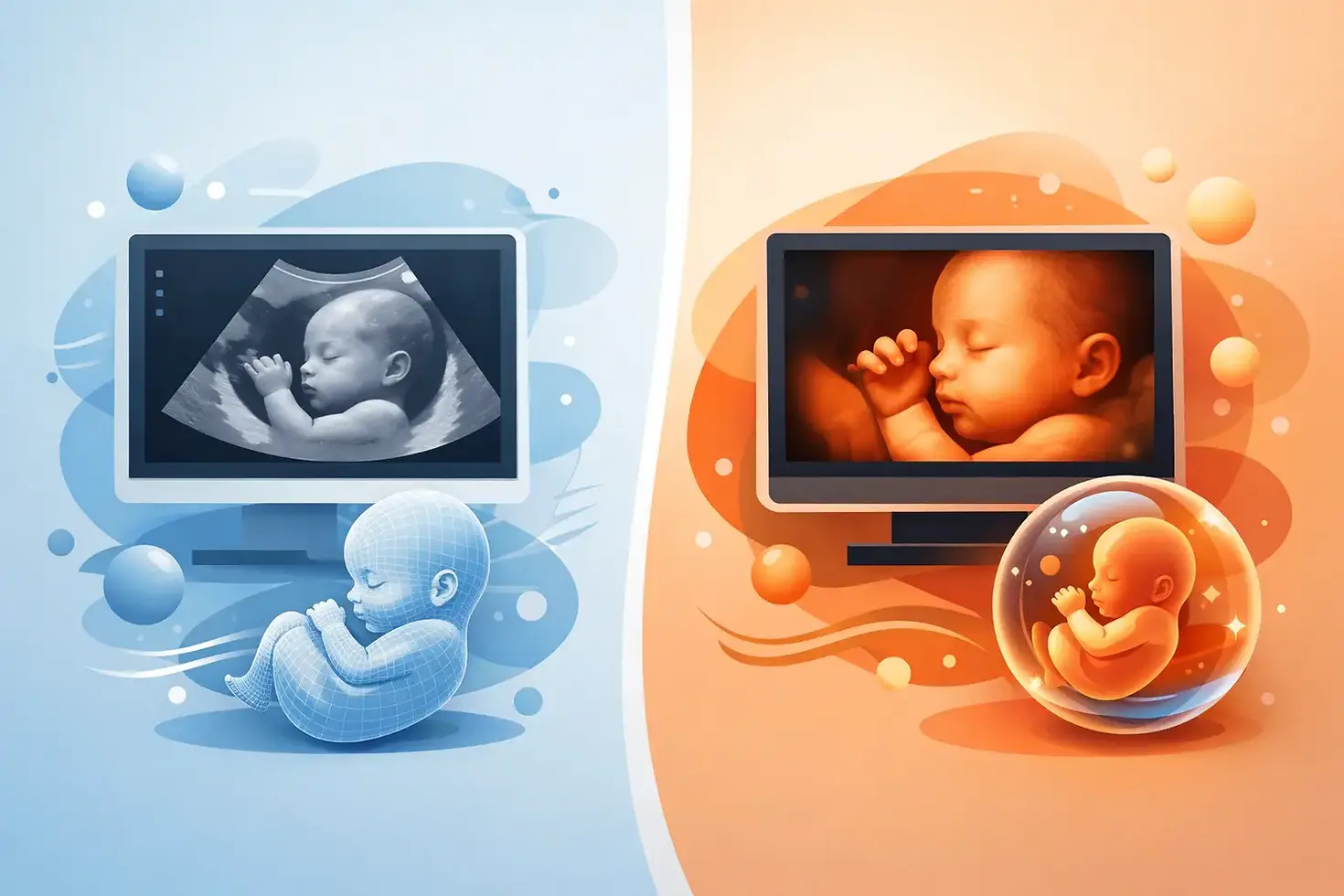
For many expectant parents, the choice sounds bigger than it really is. Both scan types use ultrasound to create more detailed images of your baby than standard 2D views. The main difference is simple. A 3D scan produces still, three-dimensional images, while a 4D scan shows those 3D images in real time, so you may see movement such as stretching, yawning, or facial expressions.
3D vs 4D baby scan: the key difference
A 3D baby scan builds a still image using multiple ultrasound angles. This can give a more defined view of your baby's face or body shape than a traditional black-and-white 2D image. Parents often choose it because the pictures feel more lifelike and easier to recognise.
A 4D baby scan uses the same three-dimensional imaging, but adds live movement. Instead of a still image, you watch your baby moving during the scan. That live element is often what makes the experience feel especially memorable.
From a clinical point of view, neither is automatically "better" in every situation. It depends on what matters most to you. If you would love keepsake images, a 3D scan may give you exactly what you need. If you want to watch your baby moving in real time, 4D is usually the more engaging experience.
What will you actually see?
This is often the real question behind 3d vs 4d baby scan comparisons. In both cases, image quality depends on several factors, including your stage of pregnancy, your baby's position, placental location, amniotic fluid levels, and maternal body tissue. Even with advanced equipment, babies do not always cooperate.
When conditions are favourable, 3D images can show facial features, little hands, feet, and body contours with impressive clarity. A 4D scan can show those same features while your baby moves. You may see a hand rise to the face, a blink, a yawn, or a change in expression. Those moments are often what parents remember most.
That said, a 4D scan does not guarantee constant action. Sometimes babies are sleeping, turned away, or tucked into a position that limits the view. A good sonographer will always explain this honestly rather than overpromise.
When is the best time to book?
Timing makes a real difference. For most 3D and 4D baby scans, the ideal window is usually between 24 and 32 weeks of pregnancy. During this stage, your baby has developed enough subcutaneous fat to make facial features appear clearer, while there is often still enough room and fluid to capture good views.
If you book too early, the images may be less defined because the baby is still relatively lean. If you book too late, space becomes more limited, and the baby may be more curled up or engaged lower in the pelvis. That can make it harder to obtain clear facial images.
There are exceptions, of course. Twins, placental position, and individual pregnancy factors can all influence ideal timing. That is why personalised advice from an experienced clinic matters. It is not just about fitting you into a diary slot. It is about giving you the best chance of a good scan experience.
Is 3D or 4D better earlier in pregnancy?
Earlier on, the distinction matters less than many people think. Before the ideal imaging window, both 3D and 4D can be more limited simply because of your baby's stage of development. You may still have a lovely experience, but expectations should be realistic. If your main aim is detailed facial imaging, waiting for the recommended gestation is usually worthwhile.
Is a 4D scan more reassuring than a 3D scan?
Sometimes parents ask this after a previous loss, a difficult pregnancy experience, or a period of worry between NHS appointments. It is understandable. Seeing your baby moving can feel deeply comforting.
A 4D scan can certainly add a sense of connection and reassurance because movement is visible in real time. However, reassurance should come from the quality of the scan and the expertise of the professional performing it, not just from whether the images move. A calm, clinically trained sonographer who explains what they are seeing is often more important than the format alone.
In other words, 4D may feel more emotionally reassuring, but the value of the appointment depends on the standard of care behind it.
3D vs 4D baby scan for bonding
For bonding, both options can be special. A 3D image can turn an abstract idea into a recognisable little face. For some parents, that still picture is the moment pregnancy suddenly feels real.
A 4D scan often goes one step further because it adds behaviour and expression. Watching your baby move, suck a thumb, or shift position can feel surprisingly personal. Partners, siblings, and grandparents often find 4D especially meaningful because the live image is easier to interpret than standard 2D ultrasound.
Still, bonding is personal. Some families are perfectly happy with beautiful still images and do not feel they need a live scan. Others know they will treasure the movement most. There is no wrong choice here.
Does one scan give better pictures?
Not necessarily. This is one of the biggest misconceptions in the 3d vs 4d baby scan discussion. A 4D scan is not automatically clearer than a 3D scan. Because 4D is essentially 3D in motion, image quality depends on the same underlying factors and the quality of the equipment being used.
In some cases, a carefully captured 3D still image can look sharper than a moment from a live 4D sequence. The sonographer may freeze and optimise a still frame to give you the best possible keepsake image. So if your priority is a standout printed image, 3D may be just as satisfying.
Why images sometimes vary
The baby may be facing the placenta, curled up, or have hands across the face. Maternal hydration can play a part, and so can how far along you are. Even the best machine cannot create a perfect facial image if the view is physically blocked. Honest guidance before and during the appointment helps avoid disappointment.
Are 3D and 4D scans safe?
When performed appropriately by qualified professionals, ultrasound is widely used in pregnancy care. Private scans should always be carried out responsibly, with proper attention to safety, training, and clinical standards.
This is why credentials matter. Expectant parents should feel confident that their scan is being performed by a properly trained sonographer in a regulated setting using suitable equipment. The experience should feel warm and personal, but never casual about clinical standards.
How to choose between them
The decision usually comes down to what you want from the appointment. If you mainly want clear still images to keep and share, a 3D scan may be enough. If you want to see your baby move in real time and enjoy a more immersive experience, 4D is often the better fit.
It is also worth considering your expectations. If your baby is in a difficult position on the day, a still 3D image may still be captured beautifully, while a full live 4D experience can be more variable. That does not make one option better than the other. It simply means outcomes depend on your pregnancy as much as the technology.
At a clinic such as Nu Scan Ultrasound, the most valuable part of the experience is not only the images themselves, but the combination of advanced imaging, clear communication, and genuinely patient-centred care.
The question behind the question
Often, when people ask about 3d vs 4d baby scan, they are really asking, "Which one will help me feel closer to my baby?" For some, that comes from a beautifully detailed still image. For others, it comes from watching a tiny yawn or stretch on screen.
Both can be lovely. Both can be worthwhile. The best choice is the one that matches what you need from the scan, with realistic expectations and the reassurance of experienced hands guiding the appointment.
If you are unsure, choose the clinic before you choose the format. The right team will explain your options clearly, advise on the best timing, and make sure the experience feels calm, informed, and personal from the moment you arrive.


Comments